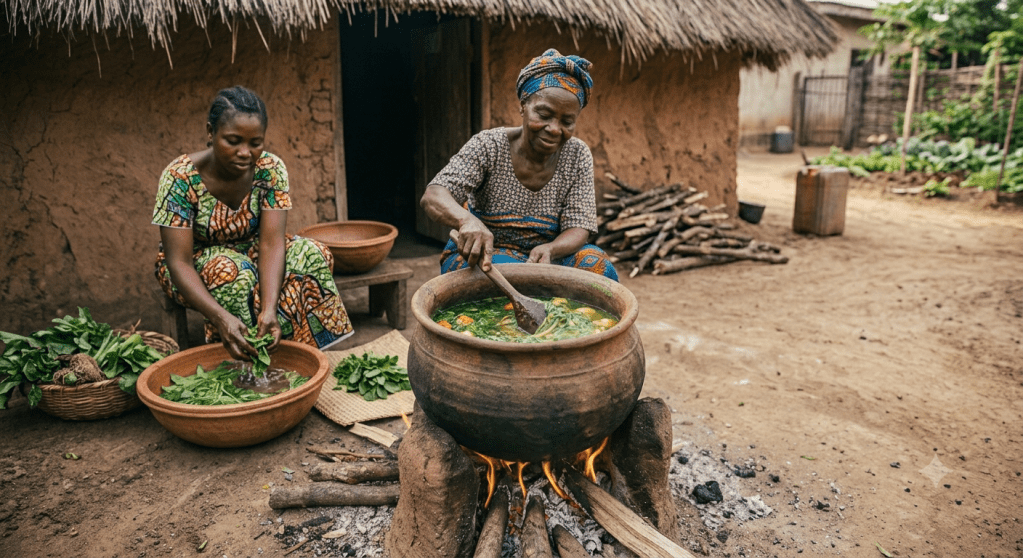
It looked like an ordinary pot of soup.
Leaves simmered gently over the fire. Someone stirred it occasionally while another woman washed vegetables nearby. There was nothing about the scene that suggested I was watching medicine being prepared.
If you had walked into the compound that afternoon, you would probably have thought lunch was almost ready.
So did I.
During my fieldwork on indigenous maternal healthcare among the Yoruba, I spent many days watching traditional birth attendants care for pregnant women. I expected to see medicinal plants, herbal mixtures, and perhaps remedies prepared in ways unfamiliar to me.
What I did not expect was to find medicine in a soup pot.
One of the women smiled when she noticed me watching.
“This one is not just food,” she said.
“It is for her blood.”
That simple sentence completely changed how I understood what I was seeing.
The woman she pointed to was pregnant. She had been feeling unusually weak, and the traditional birth attendant believed she needed to “build blood”: an expression familiar in many Nigerian homes but one that carried a deeper meaning here.
Instead of reaching for packaged supplements, the birth attendant reached for fresh leaves.
Pumpkin leaves.
Other vegetables gathered from nearby farms and markets.
Sometimes the leaves were squeezed to extract their juice before being mixed with milk. At other times, they were cooked into soup and eaten as part of an ordinary meal.
To someone unfamiliar with Yoruba Indigenous Knowledge Systems, it might have seemed impossible to tell where the food ended and the medicine began.
That is because, in many cases, there was no boundary.
The more time I spent with knowledge holders, the more I realized that they rarely separated nutrition from healing.
A meal could nourish.
The same meal could treat.
The same ingredients growing quietly in a backyard could become part of a carefully considered response to pregnancy-related weakness.
One traditional birth attendant explained that different women required different foods depending on what their bodies were experiencing. There was no single prescription for everyone. Care was adjusted according to the woman’s condition, her pregnancy, and how she responded over time.
It reminded me that personalised medicine did not begin with modern technology.
It has existed in many forms for generations.
What struck me most was how ordinary everything looked.
There were no labelled bottles.
No blister packs.
No printed dosage instructions.
Just familiar vegetables that many families already cooked every week.
Yet within this community, they were understood through generations of accumulated knowledge, not merely as ingredients, but as therapeutic resources carefully selected to support pregnancy.
That afternoon, I stopped thinking about the old question of whether something was “food” or “medicine.”
The women I was learning from had never accepted that distinction in the first place.
 bridgingbirth