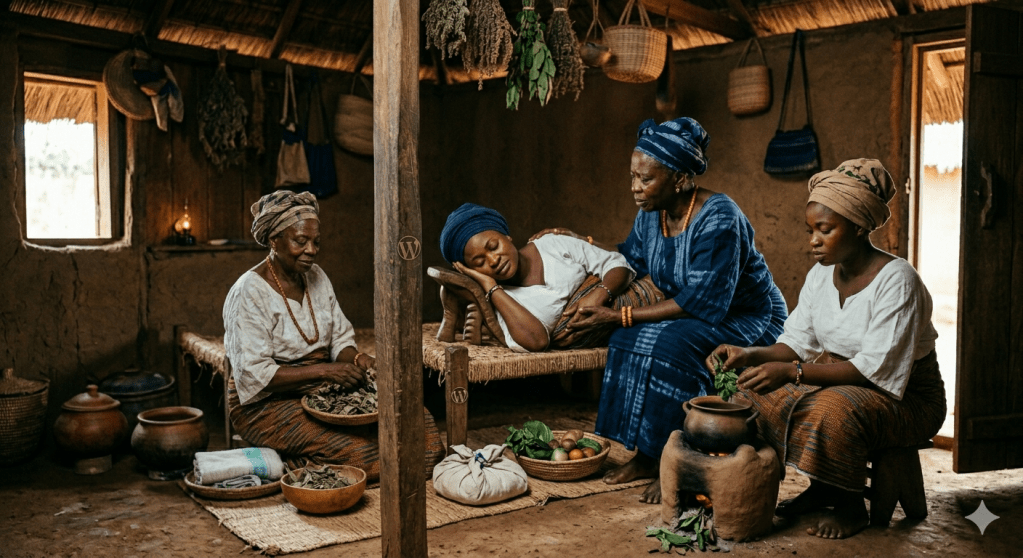
A woman begins to notice the changes in her body. Before any test is taken, before any clinic is visited, those around her begin to read the signs with her. Advice is offered quietly: what to eat, how to rest, what to avoid. Care begins here, in ways that are rarely recorded but deeply understood.
In many communities, maternal health does not begin in hospitals. It begins in knowledge; knowledge that is shared, practiced, and carried across generations. It is found in the attentiveness of caregivers, in the guidance of traditional birth attendants, and in the everyday practices that shape pregnancy, childbirth, and recovery.
Yet, these Indigenous Knowledge Systems are often absent from dominant conversations about maternal health, which tend to prioritize clinical frameworks and measurable outcomes. While these are important, they do not fully capture the lived realities of care in many parts of the world.
This space is an attempt to begin from a different place.
It is dedicated to exploring how Indigenous Knowledge Systems shape maternal care, not as relics of the past, but as living, evolving systems that continue to sustain women and communities. Through stories, reflections, and engagement with community knowledge holders, this platform seeks to document and think with these practices.
Here, maternal health is understood not only as a medical concern, but as a social, cultural, and relational process.
What you will find here are stories from the field, voices of caregivers and traditional birth attendants, reflections on research, and conversations that bridge Indigenous and biomedical understandings of care.
This is not a space that claims to have all the answers. It is a space that begins with attention, with a willingness to see, listen, and learn from forms of knowledge that have long been present, even when they are not always recognized.
To understand maternal health, we must look beyond where it is measured, to where it is lived.
 bridgingbirth