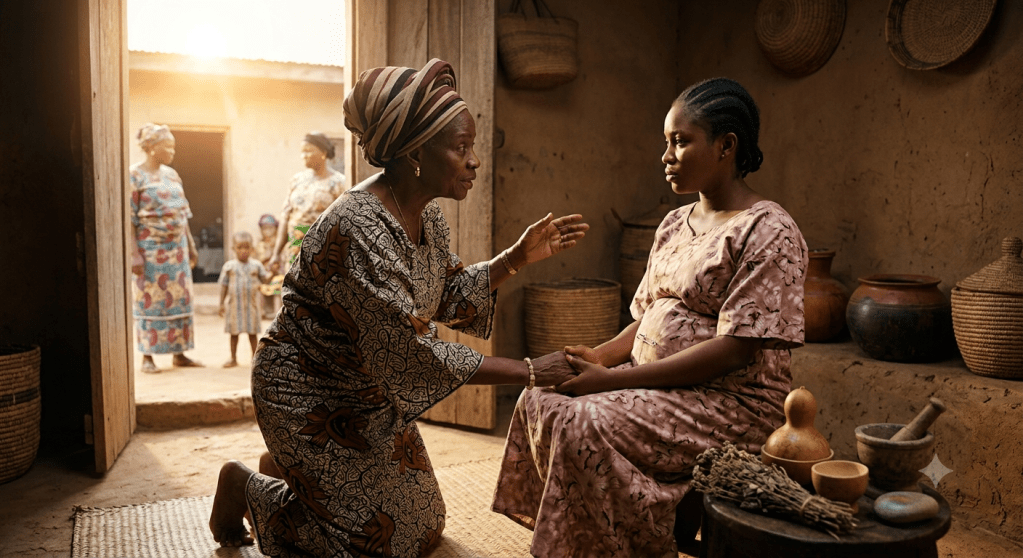
The young woman adjusted her wrapper and reached for the door.
It was just after one in the afternoon. The market was only a short walk away, and she wanted to buy vegetables before the evening rush.
Before she could step outside, her mother-in-law called from the courtyard.
“Nibo lo n lọ?” she asked.
“To the market.”
The older woman looked toward the blazing afternoon sun before turning back to her daughter-in-law.
“Not now.”
“But it’s only the market.”
She shook her head.
“Come back inside. A pregnant woman does not walk under this sun.”
The younger woman sighed, convinced it was another one of the many rules that suddenly seemed to govern her life. Don’t stay out late. Wear a safety pin whenever you go to the market. Don’t let anyone cross over your stretched legs. Don’t whistle at night. Don’t…
For many women, pregnancy in Yorubaland is accompanied by a long list of instructions. To outsiders, they can appear restrictive, mysterious, or even irrational. Yet during my conversations with traditional birth attendants, mothers, and elderly men and women, I discovered that these instructions were never described as arbitrary rules. They were acts of protection.
Protection for the mother.
Protection for the unborn child.
Protection for a journey considered too precious to be left to chance.
One of the most common instructions concerns time itself. Many Yoruba elders discourage pregnant women from walking outside between one and three o’clock in the afternoon or moving about late at night. Within Yoruba belief, these are periods when unseen forces are especially active, making the expectant mother and her unborn child spiritually vulnerable.
Whether one shares this belief or not, the practice also reveals another layer of wisdom. Avoiding the intense afternoon sun reduces exposure to extreme heat, dehydration, and exhaustion. Staying indoors after dark minimizes encounters with physical dangers, including crime and accidents, at a time when mobility and balance are already affected by pregnancy.
The same layered thinking appears in another familiar practice: fastening a small safety pin to a pregnant woman’s clothing before entering crowded places such as markets.
Many Yoruba families explain this through the symbolism of iron (irin), the sacred metal associated with Ògún, the deity of iron, craftsmanship, and protection. Iron is believed to possess a potent force capable of clearing pathways and shielding people from harmful spiritual influences. A simple safety pin therefore becomes more than a household object; it becomes a quiet declaration that both mother and child are under protection.
Others have offered a different interpretation. They suggest that the safety pin provides psychological reassurance during pregnancy, helping women feel safer in environments that can otherwise feel unpredictable. That sense of security may itself reduce anxiety, illustrating how cultural practices can support emotional well-being alongside spiritual conviction.
Another instruction I heard repeatedly concerned something as ordinary as sitting down.
“If you stretch out your legs,” one elderly woman warned me, “don’t let anyone step across them.”
Within Yoruba belief, allowing someone to cross over the legs of a pregnant woman may interfere with the baby’s journey into the world, potentially leading to a difficult birth.
Again, there is another way to understand the practice. A woman sitting with her legs extended creates a tripping hazard. Someone stumbling over her legs could fall onto her abdomen or pull her from her seat, placing both mother and child at risk. Even without an accident, remaining in that position for extended periods can increase strain on the lower back and pelvis during pregnancy.
The more stories I listened to, the more I realized these practices were doing something remarkable.
They transformed everyday behaviour into a culture of care.
A grandmother’s warning was more than a warning. A safety pin was more than a piece of metal. Waiting until the sun softened before leaving home was more than caution.
Together, these practices created an environment in which pregnancy was treated as something worthy of constant attention and collective responsibility.
Perhaps that is the question these traditions invite us to ask today.
Instead of dismissing them as mere taboos, what happens when we begin to see them as Indigenous public health practices: systems of care that weave together spirituality, environmental knowledge, psychology, and generations of lived experience?
Sometimes, hidden beneath what appears to be a simple cultural rule is an entire philosophy about how a community chooses to protect life before birth.
 bridgingbirth