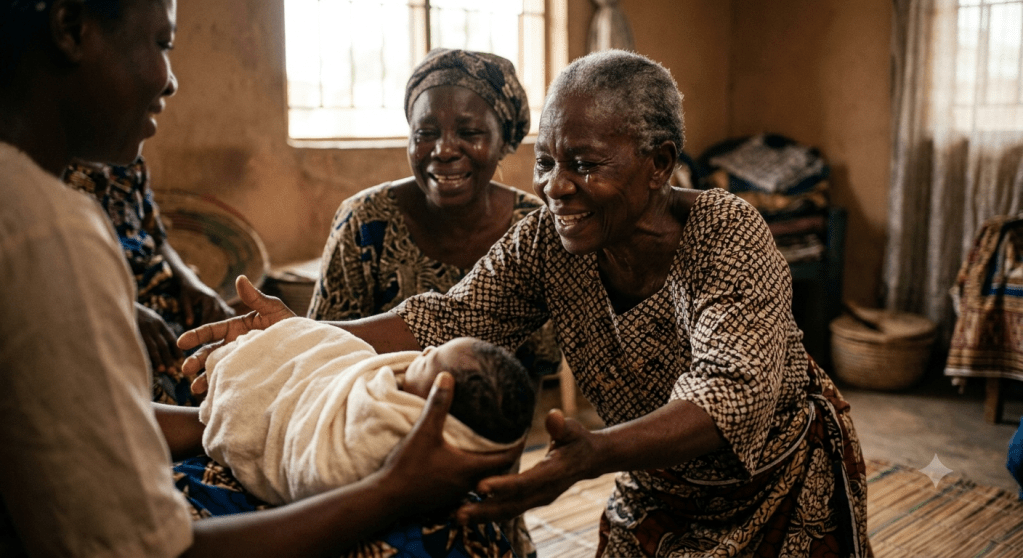
The first cry of the baby had barely faded when the room erupted, not in applause, but in recognition.
“Kaabo Baba mi!” an elderly woman exclaimed as she stretched out her arms toward the newborn. “Welcome back, my father.”
Another woman smiled through her tears. “He has finally returned.”
Nobody in the room seemed surprised by the greeting. There were no puzzled faces asking who the old man was or why everyone was welcoming him into the body of a newborn child. To them, the answer was obvious. A child had not merely been born; an ancestor had found the way home.
Months later, while speaking with traditional birth attendants and elderly women in Yoruba communities, I heard variations of this story over and over again. Sometimes the welcome was Kaabo Iya mi “Welcome back, my mother.” Sometimes the baby would later be named Babatunde, Yetunde, or Iyabo, names that quietly announce to the world that someone beloved has returned.
One elderly woman laughed as she recalled how, when a baby cried endlessly, family members would abandon the child’s given name and instead call the name of the deceased ancestor they believed had returned.
Adunbi, ma sunkún mọ́, they would say. “Adunbi, don’t cry anymore.”
Whether or not the child’s official name was Adunbi hardly mattered. What mattered was acknowledging who the family believed the child truly was.
That conversation changed the way I thought about pregnancy.
For many of us today, pregnancy begins with a positive test, a hospital registration card, or the first ultrasound image. But among many Yoruba families, pregnancy begins much earlier and with a very different imagination. It is not simply the biological development of a fetus. It is the anticipated return of lineage, memory, and ancestry. A pregnancy carries not only a child but also the possibility of reconnecting the living with those who came before them.
Once pregnancy is understood this way, many aspects of Yoruba maternal care begin to make sense.
Why do families become anxious when a newly married woman does not conceive? Why are mothers and mothers-in-law often the first to seek prayers, herbal remedies, or spiritual intervention? Why is pregnancy surrounded by rituals, advice, restrictions, and careful observation?
The answer lies beyond reproduction. Pregnancy is viewed as a sacred passage through which Ẹlẹ́dùmarè permits families to welcome another generation and perhaps, the return of an ancestor. Protecting the expectant mother therefore becomes much more than safeguarding her health; it becomes safeguarding a sacred journey.
This is where my own journey into Indigenous maternal healthcare began, not with medicinal plants or traditional birth attendants, but with a simple greeting spoken to a newborn child.
“Welcome back.”
In those two words lies an entire philosophy of pregnancy, motherhood, family, and care.
Over the coming weeks, this blog will explore that philosophy through stories gathered from traditional birth attendants, mothers, herbal practitioners, and elders across Yorubaland. Together, we will see that long before hospitals and maternity wards became central to childbirth, communities had already developed rich systems of knowledge about caring for pregnancy: systems rooted in memory, spirituality, ecology, and generations of lived experience.
 bridgingbirth
Leave a comment