Author: damilolaibitogbe

  • Why Everyone Was Asked to Leave the Room…………..

    Why Everyone Was Asked to Leave the Room…………..

    It happened so quietly that I almost missed it.

    One moment, people were moving freely around the compound. A few women chatted beneath a mango tree. Someone laughed in the distance. A child wandered past the doorway before being called back by his mother.

    Then everything changed.

    One of the traditional birth attendants looked around the courtyard and spoke just loudly enough for everyone to hear.

    “Ẹ jẹ́ kí gbogbo ènìyàn jáde.”

    Everyone should leave.

    Nobody argued.

    Nobody asked why.

    Within moments, the room was empty.

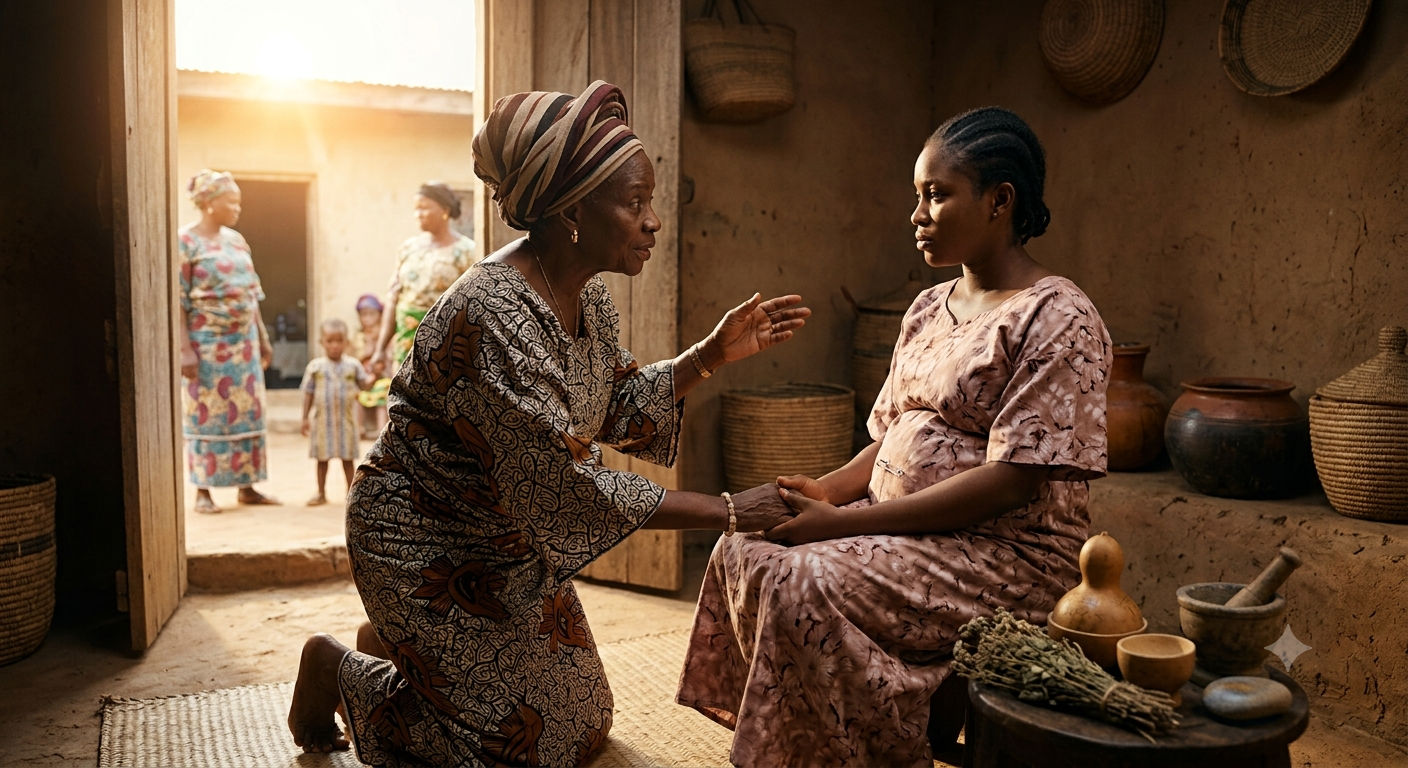
    Only the pregnant woman and the birth attendant remained inside.

    As an ethnographer, moments like these make you curious. You begin asking yourself questions long before you ask anyone else.

    What was happening behind that door?

    Was the woman in danger?

    Was this a ritual?

    Or was I simply witnessing a level of privacy that I had not expected?

    Later, the birth attendant explained.

    The baby was lying in the wrong position.

    What many hospitals describe as a breech presentation, she understood as a condition requiring not only knowledge of the body but careful attention to the circumstances surrounding it.

    “The room must be quiet,” she told me.

    “Too many people bring too many things with them.”

    She was not talking about noise.

    She was talking about presence.

    Within Yoruba Indigenous Knowledge Systems, childbirth is never understood as a purely mechanical process. While physical examination matters, many practitioners also believe that unseen influences, jealousy, fear, negative intentions, or spiritual disturbance can interfere with a woman’s labour.

    Whether readers share that belief is beside the point.

    What mattered to me was understanding how that belief shaped practice.

    Privacy was not simply about protecting a woman’s dignity.

    It was itself considered part of the treatment.

    Only after the room had been cleared did the birth attendant begin preparing the remedy.

    A mature snail.

    Fresh Efo Worowo leaves.

    Traditional black soap.

    The ingredients were boiled, pounded together into a paste, and carefully applied as she worked to encourage the baby to return to a head-down position.

    But even then, I found myself thinking less about the herbs than about the empty room.

    In many hospitals, privacy protects confidentiality.

    Here, privacy was believed to protect the birth itself.

    That distinction fascinated me.

    As researchers, we often arrive in communities looking for medicines, recipes, or techniques. We make lists of plants, identify botanical names, and ask what each remedy is used for.

    Yet some of the most important knowledge cannot be pressed between the pages of a herbarium.

    It lives in practices.

    In gestures.

    In decisions.

    Like asking everyone to leave the room before care begins.

    That afternoon taught me that Indigenous Knowledge Systems are not only about what people use to heal.
    They are also about how healing is made possible.
    And sometimes, healing begins with closing a door.

  • The Soup That Was Also a Prescription………..

    The Soup That Was Also a Prescription………..

    It looked like an ordinary pot of soup.

    Leaves simmered gently over the fire. Someone stirred it occasionally while another woman washed vegetables nearby. There was nothing about the scene that suggested I was watching medicine being prepared.

    If you had walked into the compound that afternoon, you would probably have thought lunch was almost ready.

    So did I.

    During my fieldwork on indigenous maternal healthcare among the Yoruba, I spent many days watching traditional birth attendants care for pregnant women. I expected to see medicinal plants, herbal mixtures, and perhaps remedies prepared in ways unfamiliar to me.

    What I did not expect was to find medicine in a soup pot.

    One of the women smiled when she noticed me watching.

    “This one is not just food,” she said.

    “It is for her blood.”

    That simple sentence completely changed how I understood what I was seeing.

    The woman she pointed to was pregnant. She had been feeling unusually weak, and the traditional birth attendant believed she needed to “build blood”: an expression familiar in many Nigerian homes but one that carried a deeper meaning here.

    Instead of reaching for packaged supplements, the birth attendant reached for fresh leaves.

    Pumpkin leaves.

    Other vegetables gathered from nearby farms and markets.

    Sometimes the leaves were squeezed to extract their juice before being mixed with milk. At other times, they were cooked into soup and eaten as part of an ordinary meal.

    To someone unfamiliar with Yoruba Indigenous Knowledge Systems, it might have seemed impossible to tell where the food ended and the medicine began.

    That is because, in many cases, there was no boundary.

    The more time I spent with knowledge holders, the more I realized that they rarely separated nutrition from healing.

    A meal could nourish.

    The same meal could treat.

    The same ingredients growing quietly in a backyard could become part of a carefully considered response to pregnancy-related weakness.

    One traditional birth attendant explained that different women required different foods depending on what their bodies were experiencing. There was no single prescription for everyone. Care was adjusted according to the woman’s condition, her pregnancy, and how she responded over time.

    It reminded me that personalised medicine did not begin with modern technology.

    It has existed in many forms for generations.

    What struck me most was how ordinary everything looked.

    There were no labelled bottles.

    No blister packs.

    No printed dosage instructions.

    Just familiar vegetables that many families already cooked every week.

    Yet within this community, they were understood through generations of accumulated knowledge, not merely as ingredients, but as therapeutic resources carefully selected to support pregnancy.

    That afternoon, I stopped thinking about the old question of whether something was “food” or “medicine.”

    The women I was learning from had never accepted that distinction in the first place.

    Perhaps that was the real lesson hidden inside the soup pot.
    Sometimes the most powerful prescriptions don’t come from a pharmacy.
    Sometimes they begin in the kitchen.

  • The Midwife That Asked A Different Question……………

    The Midwife That Asked A Different Question……………

    The labour had gone on for hours.

    The baby’s head had not appeared.

    The woman’s cries had become weaker.

    Around her, family members waited anxiously, wondering why nothing seemed to be happening.

    If this story had unfolded inside a modern hospital, the conversation might have turned immediately to cervical dilation, fetal position, or the possibility of a Caesarean section.

    But that was not the first question the traditional birth attendant asked.

    When I interviewed one experienced Yoruba midwife during my fieldwork, she told me something I have not forgotten.

    “When a woman’s labour is delayed,” she said, “I first ask why.”

    She explained that not every prolonged labour has the same cause. Some, she believed, arise from physical complications. Others require understanding something beyond what the eyes can see.

    Only after deciding what kind of problem she was dealing with would she begin treatment.

    She described her process quietly, almost as though it were the most ordinary thing in the world.

    If she concluded that the obstruction was spiritual, she would first turn her own clothes inside out before putting them back on.

    Then she would change the mother’s position.

    Only then would she prepare the herbs.

    Around her home grew plants she had cultivated over many years, not simply because they were medicinal, but because she trusted them.

    She would pluck fresh leaves of Ewe Lapalapa, Ewe Ewuro, and Ajekobale, pound them together with traditional black soap, and prepare a herbal bath.

    To an outsider, it might seem like a collection of unrelated actions.

    To her, every step belonged to the same system of care.

    What fascinated me most was not whether someone reading this believes in spiritual causes of prolonged labour.

    It was the clinical logic behind her practice.

    She did not begin with treatment.

    She began with diagnosis.

    She believed that effective care depended on correctly understanding the nature of the problem before choosing the remedy.

    That is a principle every healthcare system values, even if different systems define illness in different ways.

    Too often, Indigenous healthcare is portrayed as though practitioners simply administer herbs whenever someone falls ill.

    My conversations suggested something far more sophisticated.

    The herbs were never the starting point.

    Observation came first.

    Interpretation came next.

    Treatment followed.

    Whether that treatment involved medicinal plants, changes in posture, ritual actions, or a combination of all three depended on the diagnosis the practitioner reached.

    As I left her home that afternoon, I realized that I had spent years thinking of Indigenous medicine as a collection of remedies.

    She had quietly shown me something different.

    It is also a way of asking questions.
    And sometimes, the questions tell us as much about a healthcare system as the medicines themselves.

  • What a Yoruba Midwife Taught Me About Seeing Pregnancy……………

    What a Yoruba Midwife Taught Me About Seeing Pregnancy……………

    There was no ultrasound machine in the room.

    No examination couch. No blood pressure monitor. No laboratory request forms.

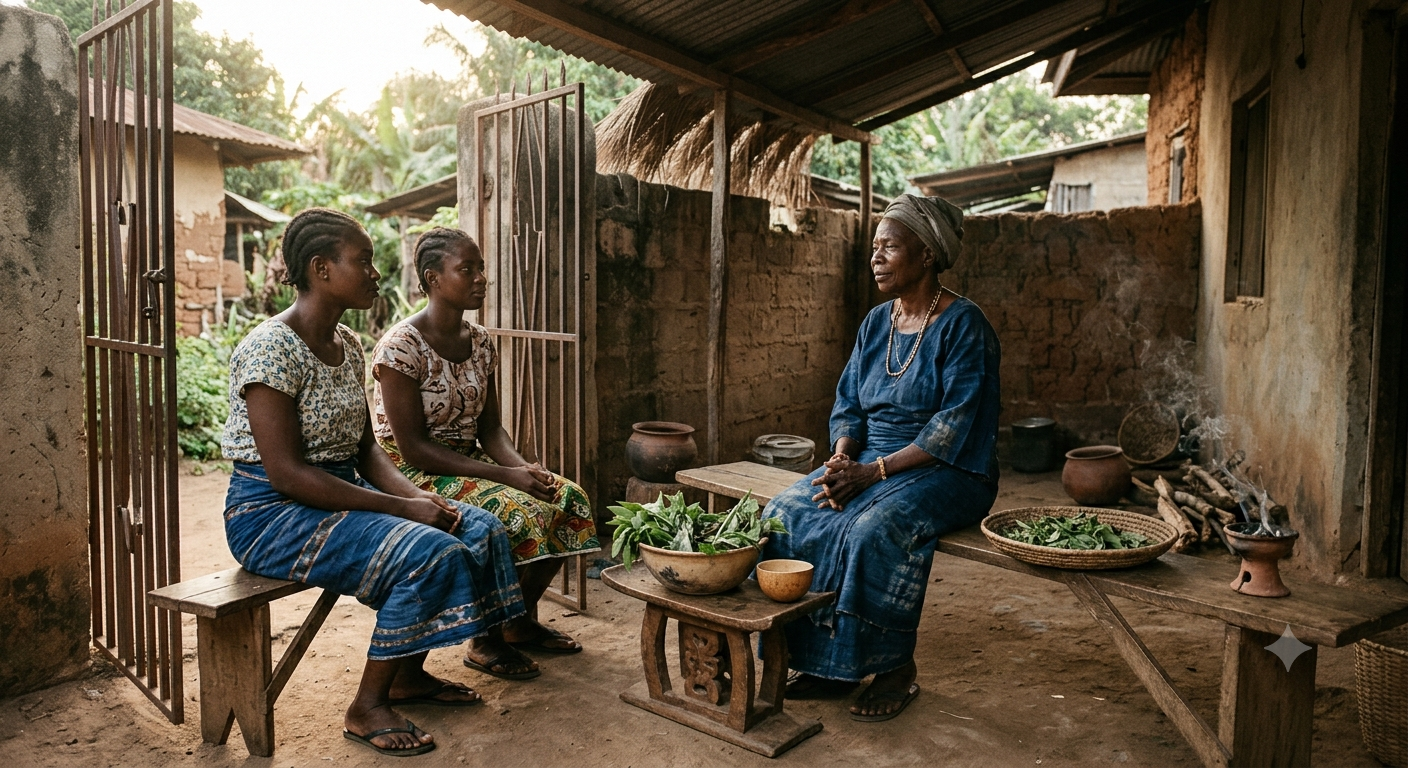
    Just an elderly woman sitting quietly on a wooden bench, waiting for the next person to walk through her gate.

    When I first began documenting indigenous maternal healthcare among the Yoruba, I assumed pregnancy became “real” only after the signs we have all come to recognize; a missed period, a growing belly, perhaps an ultrasound image proudly shared with family and friends.

    Then I met Iya Ewe.

    She smiled when I asked how she knew a woman was pregnant.

    “You people wait until the stomach grows,” she said. “We don’t.”

    Over the following weeks, I watched women arrive at her home. Some looked no different from any other woman in the community. They laughed, chatted, and carried themselves as though nothing had changed. Yet, according to the traditional birth attendants, pregnancy had already begun its quiet work inside their bodies.

    To these knowledge holders, pregnancy is not something that suddenly appears when the abdomen expands. It reveals itself through subtle changes that generations of observation have taught them to recognize.

    But what fascinated me even more was what happened after they confirmed a pregnancy.

    For the women in their care, antenatal care began immediately.

    Not with registration forms.

    Not with numbered clinic cards.

    With conversation.

    They asked about the woman’s body.

    Her appetite.

    Her sleep.

    Her previous pregnancies.

    Her fears.

    Her family.

    And then came a question I had never imagined anyone would ask.

    “What kind of child is she carrying?”

    At first, I thought they were asking whether the baby was a boy or a girl.

    They were not.

    They explained that every pregnancy carries its own story. Some pregnancies progress easily. Others require closer attention, not simply because of physical symptoms but because the unborn child may have spiritual circumstances that need to be understood.

    One traditional birth attendant explained it this way:

    “It is not enough to know that a woman is pregnant. We must also know the kind of child she is carrying and whether there are spiritual issues that can affect the pregnancy or the delivery.”

    Whether one agrees with this worldview or not, it reveals something important about Indigenous Knowledge Systems.

    Health is never reduced to the body alone.

    The physical, emotional, social, environmental, and spiritual are understood as interconnected. Pregnancy is therefore monitored not only for signs of illness but also for signs that the mother may need reassurance, dietary changes, herbal support, massage, or spiritual protection.

    No two women receive exactly the same care.

    One may leave with herbs for persistent nausea.

    Another with dietary advice.

    Another with instructions to return in a few days for further observation.

    Another simply needs someone to reassure her that what she is experiencing is normal.

    The care is remarkably personal!

    Too often, conversations about maternal healthcare in Africa are framed as a choice between “traditional” and “modern” medicine.

    My time with Yoruba knowledge holders suggested a more interesting question.

    What if we first tried to understand how these systems think before deciding whether they fit neatly into categories we have already created? That, perhaps, was one of the most unexpected lessons my fieldwork gave me.

  • This is Not Just A Job!

    During one of my field encounters, i asked what seemed like the simplest question.

    “So…what do you do?”

    The elderly birth attendant smiled.

    “I don’t have a job,” he replied.

    For a moment, I thought I had misunderstood him.

    Then he continued.

    “This is not work.”

    “It is service.”

    Over the following hour, he explained that babies are born at inconvenient hours. Labour does not wait until morning. Families call without warning. Sometimes there is payment.

    Sometimes there isn’t.

    Yet he still goes.

    Another practitioner described the profession differently.

    “This work is Iṣẹ́ Ayé.”

    A calling.

    A responsibility.

    A trust placed in human hands by God.

    As I listened to birth attendants in Eti-Oni and Osogbo, I noticed that almost none of them measured success by income.

    Instead, they spoke about mothers who returned years later carrying another child.

    Families who still visited to say thank you.

    Children they had delivered now bringing their own wives for care.

    Of course, the work is changing.

    Many practitioners told me younger generations trust hospitals more than traditional birth attendants. Others admitted that patients often fail to complete treatment or return for follow-up visits.

    Yet rather than disappearing, these practitioners are adapting.

    Many now schedule appointments.

    They answer phone calls.

    Some combine Indigenous knowledge with referrals to biomedical facilities when necessary.

    Their profession has evolved without abandoning its foundations.

    Perhaps that is the greatest lesson Indigenous maternal healthcare offers us.

    Tradition survives not because it refuses change.

    It survives because it knows how to change without forgetting who it is.

    A Question to Carry Home

    Can a profession be measured only by the income it earns or should it also be measured by the lives, relationships, and communities it sustains?

  • I Smelt Them Before i Saw Them……..

    Before I saw them, I smelled them.

    The sharp scent of dried roots.

    Fresh leaves stacked in woven baskets.

    Tree bark tied into neat bundles.

    Seeds, spices, powders, shells, and bottles arranged with remarkable precision.

    Hidden among traders selling tomatoes, peppers, and yam sat another kind of marketplace.

    This was where the Lekuleja worked.

    To many visitors, they looked like ordinary market women.

    To the communities they served, they were something else entirely.

    “Tell me what is wrong,” one woman asked a customer.

    She didn’t immediately reach for a bundle of herbs.

    She asked questions.

    How many months pregnant?

    Has she been eating?

    Is she sleeping well?

    Has she been to the clinic?

    Only after listening carefully did she begin selecting leaves, roots, and bark.

    Watching this exchange, I realized the Lekuleja were doing far more than selling medicinal plants.

    They were translating generations of knowledge into everyday care.

    Many of the women I interviewed explained that younger generations no longer recognized the plants their grandmothers once gathered themselves. Instead of searching forests or family gardens, they now came to the market.

    The knowledge had not disappeared.

    It had changed address.

    Today, the Lekuleja have become custodians of knowledge that once lived inside households. They know which leaf is prepared as tea, which bark must be boiled, which root should never be mixed with another, and why dosage matters.

    In many ways, they function much like community pharmacists, not because they wear white coats, of course they dont. But because they preserve, interpret, and pass on therapeutic knowledge that might otherwise disappear.

    As I left the market, I looked back once more.

    What many people saw was a collection of herbs.

    What I saw was a living library.

    A Question to Carry Home

    If knowledge can disappear when those who carry it are gone, who are the libraries we walk past every day without noticing?

  • The Woman Everyone Sent Me To: Meeting The Traditional Birth Attendant

    “You should speak to Mama.”

    That was the answer I kept hearing.

    I asked about pregnancy.

    “You should speak to Mama.”

    I asked who delivered babies before hospitals became common.

    “You should speak to Mama.”

    I asked who knew the old medicines.

    Again, the same answer.

    “You should speak to Mama.”

    By the time I reached her compound, I realized something important. Nobody had called her by her profession. Nobody had introduced her by her qualifications. They simply assumed everyone knew who “Mama” was.

    When she welcomed me inside, I expected our conversation to revolve around herbs and childbirth.

    Instead, she began by talking about responsibility.

    “A woman does not come here only when labour starts,” she told me. “She comes with her fears.”

    That sentence changed everything.

    Until then, I had imagined the Agbebi as someone who helped women deliver babies. But as I spent time with traditional birth attendants in Eti-Oni and Osogbo, I discovered they were much more than midwives.

    They were counsellors before pregnancy.

    Teachers during pregnancy.

    Birth attendants during labour.

    Caregivers after delivery.

    Sometimes they accepted payment.

    Sometimes they did not.

    Sometimes they were called in the middle of the night simply because a frightened family needed someone they trusted.

    Their knowledge was learned through years of apprenticeship, family inheritance, personal curiosity, or what many described as a spiritual calling. Yet nearly every practitioner told me the same thing.

    This work cannot be done with hands alone.

    For them, childbirth was never only physical. It demanded patience, wisdom, compassion, and an awareness that every birth carried emotional, cultural, and spiritual significance.

    The more I listened, the less the title “Traditional Birth Attendant” seemed adequate.

    They were guardians of one of life’s most sacred journeys.

    A Question to Carry Home

    When we describe someone as a Traditional Birth Attendant, what parts of their work do we leave out?

  • The Hidden Wisdom Behind Yoruba Pregnancy Taboos

    The Hidden Wisdom Behind Yoruba Pregnancy Taboos

    The young woman adjusted her wrapper and reached for the door.

    It was just after one in the afternoon. The market was only a short walk away, and she wanted to buy vegetables before the evening rush.

    Before she could step outside, her mother-in-law called from the courtyard.

    “Nibo lo n lọ?” she asked.

    “To the market.”

    The older woman looked toward the blazing afternoon sun before turning back to her daughter-in-law.

    “Not now.”

    “But it’s only the market.”

    She shook her head.

    “Come back inside. A pregnant woman does not walk under this sun.”

    The younger woman sighed, convinced it was another one of the many rules that suddenly seemed to govern her life. Don’t stay out late. Wear a safety pin whenever you go to the market. Don’t let anyone cross over your stretched legs. Don’t whistle at night. Don’t…

    For many women, pregnancy in Yorubaland is accompanied by a long list of instructions. To outsiders, they can appear restrictive, mysterious, or even irrational. Yet during my conversations with traditional birth attendants, mothers, and elderly men and women, I discovered that these instructions were never described as arbitrary rules. They were acts of protection.

    Protection for the mother.

    Protection for the unborn child.

    Protection for a journey considered too precious to be left to chance.

    One of the most common instructions concerns time itself. Many Yoruba elders discourage pregnant women from walking outside between one and three o’clock in the afternoon or moving about late at night. Within Yoruba belief, these are periods when unseen forces are especially active, making the expectant mother and her unborn child spiritually vulnerable.

    Whether one shares this belief or not, the practice also reveals another layer of wisdom. Avoiding the intense afternoon sun reduces exposure to extreme heat, dehydration, and exhaustion. Staying indoors after dark minimizes encounters with physical dangers, including crime and accidents, at a time when mobility and balance are already affected by pregnancy.

    The same layered thinking appears in another familiar practice: fastening a small safety pin to a pregnant woman’s clothing before entering crowded places such as markets.

    Many Yoruba families explain this through the symbolism of iron (irin), the sacred metal associated with Ògún, the deity of iron, craftsmanship, and protection. Iron is believed to possess a potent force capable of clearing pathways and shielding people from harmful spiritual influences. A simple safety pin therefore becomes more than a household object; it becomes a quiet declaration that both mother and child are under protection.

    Others have offered a different interpretation. They suggest that the safety pin provides psychological reassurance during pregnancy, helping women feel safer in environments that can otherwise feel unpredictable. That sense of security may itself reduce anxiety, illustrating how cultural practices can support emotional well-being alongside spiritual conviction.

    Another instruction I heard repeatedly concerned something as ordinary as sitting down.

    “If you stretch out your legs,” one elderly woman warned me, “don’t let anyone step across them.”

    Within Yoruba belief, allowing someone to cross over the legs of a pregnant woman may interfere with the baby’s journey into the world, potentially leading to a difficult birth.

    Again, there is another way to understand the practice. A woman sitting with her legs extended creates a tripping hazard. Someone stumbling over her legs could fall onto her abdomen or pull her from her seat, placing both mother and child at risk. Even without an accident, remaining in that position for extended periods can increase strain on the lower back and pelvis during pregnancy.

    The more stories I listened to, the more I realized these practices were doing something remarkable.

    They transformed everyday behaviour into a culture of care.

    A grandmother’s warning was more than a warning. A safety pin was more than a piece of metal. Waiting until the sun softened before leaving home was more than caution.

    Together, these practices created an environment in which pregnancy was treated as something worthy of constant attention and collective responsibility.

    Perhaps that is the question these traditions invite us to ask today.

    Instead of dismissing them as mere taboos, what happens when we begin to see them as Indigenous public health practices: systems of care that weave together spirituality, environmental knowledge, psychology, and generations of lived experience?

    Sometimes, hidden beneath what appears to be a simple cultural rule is an entire philosophy about how a community chooses to protect life before birth.

    A Question to Carry Home: How many cultural practices have we dismissed as superstition before asking what purpose they were meant to serve?

  • ‘Welcome Back’: The Yoruba Philosophy of Pregnancy and Birth

    The first cry of the baby had barely faded when the room erupted, not in applause, but in recognition.

    “Kaabo Baba mi!” an elderly woman exclaimed as she stretched out her arms toward the newborn. “Welcome back, my father.”

    Another woman smiled through her tears. “He has finally returned.”

    Nobody in the room seemed surprised by the greeting. There were no puzzled faces asking who the old man was or why everyone was welcoming him into the body of a newborn child. To them, the answer was obvious. A child had not merely been born; an ancestor had found the way home.

    Months later, while speaking with traditional birth attendants and elderly women in Yoruba communities, I heard variations of this story over and over again. Sometimes the welcome was Kaabo Iya mi “Welcome back, my mother.” Sometimes the baby would later be named Babatunde, Yetunde, or Iyabo, names that quietly announce to the world that someone beloved has returned.

    One elderly woman laughed as she recalled how, when a baby cried endlessly, family members would abandon the child’s given name and instead call the name of the deceased ancestor they believed had returned.

    Adunbi, ma sunkún mọ́, they would say. “Adunbi, don’t cry anymore.”

    Whether or not the child’s official name was Adunbi hardly mattered. What mattered was acknowledging who the family believed the child truly was.

    That conversation changed the way I thought about pregnancy.

    For many of us today, pregnancy begins with a positive test, a hospital registration card, or the first ultrasound image. But among many Yoruba families, pregnancy begins much earlier and with a very different imagination. It is not simply the biological development of a fetus. It is the anticipated return of lineage, memory, and ancestry. A pregnancy carries not only a child but also the possibility of reconnecting the living with those who came before them.

    Once pregnancy is understood this way, many aspects of Yoruba maternal care begin to make sense.

    Why do families become anxious when a newly married woman does not conceive? Why are mothers and mothers-in-law often the first to seek prayers, herbal remedies, or spiritual intervention? Why is pregnancy surrounded by rituals, advice, restrictions, and careful observation?

    The answer lies beyond reproduction. Pregnancy is viewed as a sacred passage through which Ẹlẹ́dùmarè permits families to welcome another generation and perhaps, the return of an ancestor. Protecting the expectant mother therefore becomes much more than safeguarding her health; it becomes safeguarding a sacred journey.

    This is where my own journey into Indigenous maternal healthcare began, not with medicinal plants or traditional birth attendants, but with a simple greeting spoken to a newborn child.

    “Welcome back.”

    In those two words lies an entire philosophy of pregnancy, motherhood, family, and care.

    Over the coming weeks, this blog will explore that philosophy through stories gathered from traditional birth attendants, mothers, herbal practitioners, and elders across Yorubaland. Together, we will see that long before hospitals and maternity wards became central to childbirth, communities had already developed rich systems of knowledge about caring for pregnancy: systems rooted in memory, spirituality, ecology, and generations of lived experience.

    A Question to Carry Home
    Before we ask how the Yoruba cared for pregnancy, perhaps, we should first ask what pregnancy meant to them?

  • In the Quiet Beginnings of Care………

    A woman begins to notice the changes in her body. Before any test is taken, before any clinic is visited, those around her begin to read the signs with her. Advice is offered quietly: what to eat, how to rest, what to avoid. Care begins here, in ways that are rarely recorded but deeply understood.
     
    In many communities, maternal health does not begin in hospitals. It begins in knowledge; knowledge that is shared, practiced, and carried across generations. It is found in the attentiveness of caregivers, in the guidance of traditional birth attendants, and in the everyday practices that shape pregnancy, childbirth, and recovery.
     
    Yet, these Indigenous Knowledge Systems are often absent from dominant conversations about maternal health, which tend to prioritize clinical frameworks and measurable outcomes. While these are important, they do not fully capture the lived realities of care in many parts of the world.
     
    This space is an attempt to begin from a different place.
     
    It is dedicated to exploring how Indigenous Knowledge Systems shape maternal care, not as relics of the past, but as living, evolving systems that continue to sustain women and communities. Through stories, reflections, and engagement with community knowledge holders, this platform seeks to document and think with these practices.
     
    Here, maternal health is understood not only as a medical concern, but as a social, cultural, and relational process.
     
    What you will find here are stories from the field, voices of caregivers and traditional birth attendants, reflections on research, and conversations that bridge Indigenous and biomedical understandings of care.
     
    This is not a space that claims to have all the answers. It is a space that begins with attention, with a willingness to see, listen, and learn from forms of knowledge that have long been present, even when they are not always recognized.
     
    To understand maternal health, we must look beyond where it is measured, to where it is lived.