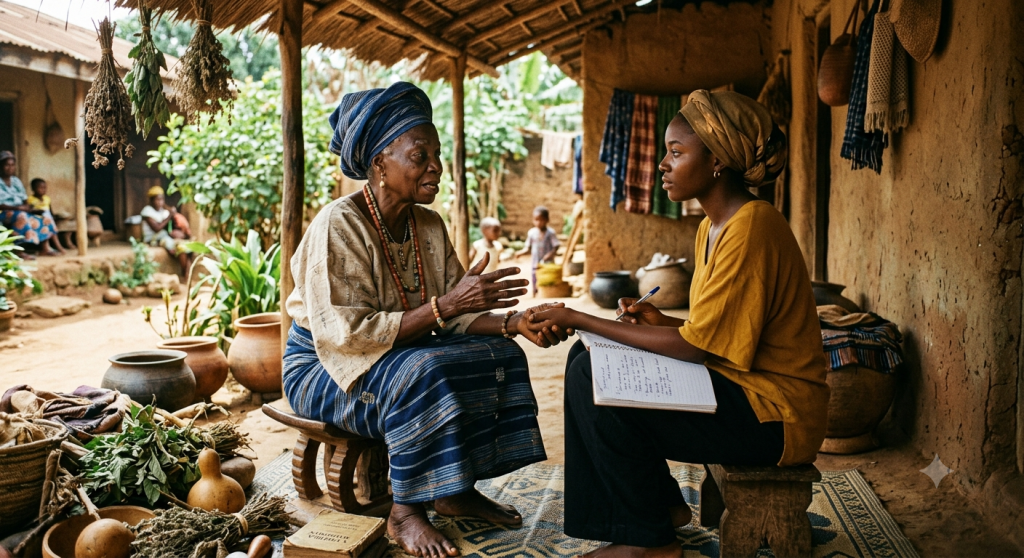
“You should speak to Mama.”
That was the answer I kept hearing.
I asked about pregnancy.
“You should speak to Mama.”
I asked who delivered babies before hospitals became common.
“You should speak to Mama.”
I asked who knew the old medicines.
Again, the same answer.
“You should speak to Mama.”
By the time I reached her compound, I realized something important. Nobody had called her by her profession. Nobody had introduced her by her qualifications. They simply assumed everyone knew who “Mama” was.
When she welcomed me inside, I expected our conversation to revolve around herbs and childbirth.
Instead, she began by talking about responsibility.
“A woman does not come here only when labour starts,” she told me. “She comes with her fears.”
That sentence changed everything.
Until then, I had imagined the Agbebi as someone who helped women deliver babies. But as I spent time with traditional birth attendants in Eti-Oni and Osogbo, I discovered they were much more than midwives.
They were counsellors before pregnancy.
Teachers during pregnancy.
Birth attendants during labour.
Caregivers after delivery.
Sometimes they accepted payment.
Sometimes they did not.
Sometimes they were called in the middle of the night simply because a frightened family needed someone they trusted.
Their knowledge was learned through years of apprenticeship, family inheritance, personal curiosity, or what many described as a spiritual calling. Yet nearly every practitioner told me the same thing.
This work cannot be done with hands alone.
For them, childbirth was never only physical. It demanded patience, wisdom, compassion, and an awareness that every birth carried emotional, cultural, and spiritual significance.
The more I listened, the less the title “Traditional Birth Attendant” seemed adequate.
They were guardians of one of life’s most sacred journeys.
A Question to Carry Home
When we describe someone as a Traditional Birth Attendant, what parts of their work do we leave out?
 bridgingbirth
Leave a comment