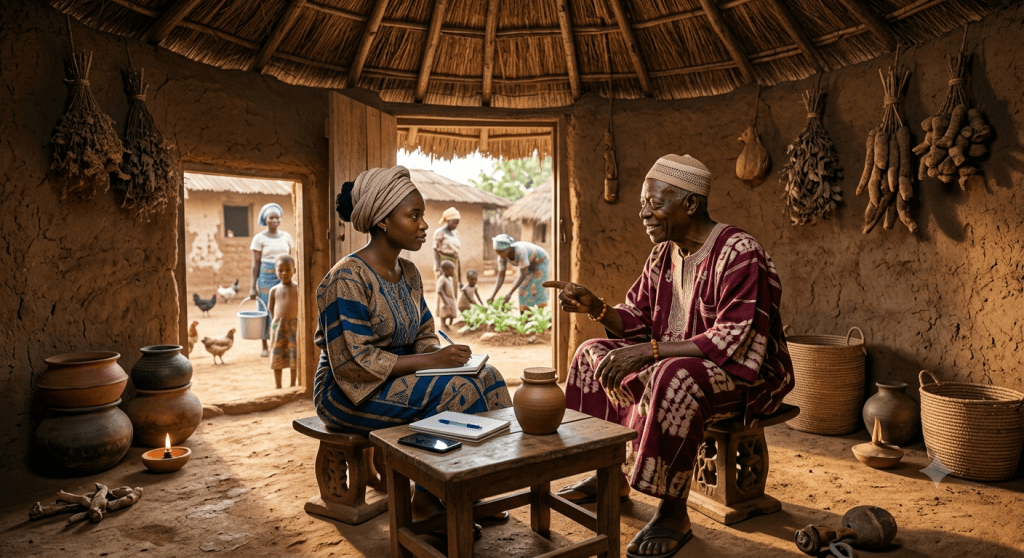
During one of my field encounters, i asked what seemed like the simplest question.
“So…what do you do?”
The elderly birth attendant smiled.
“I don’t have a job,” he replied.
For a moment, I thought I had misunderstood him.
Then he continued.
“This is not work.”
“It is service.”
Over the following hour, he explained that babies are born at inconvenient hours. Labour does not wait until morning. Families call without warning. Sometimes there is payment.
Sometimes there isn’t.
Yet he still goes.
Another practitioner described the profession differently.
“This work is Iṣẹ́ Ayé.”
A calling.
A responsibility.
A trust placed in human hands by God.
As I listened to birth attendants in Eti-Oni and Osogbo, I noticed that almost none of them measured success by income.
Instead, they spoke about mothers who returned years later carrying another child.
Families who still visited to say thank you.
Children they had delivered now bringing their own wives for care.
Of course, the work is changing.
Many practitioners told me younger generations trust hospitals more than traditional birth attendants. Others admitted that patients often fail to complete treatment or return for follow-up visits.
Yet rather than disappearing, these practitioners are adapting.
Many now schedule appointments.
They answer phone calls.
Some combine Indigenous knowledge with referrals to biomedical facilities when necessary.
Their profession has evolved without abandoning its foundations.
Perhaps that is the greatest lesson Indigenous maternal healthcare offers us.
Tradition survives not because it refuses change.
It survives because it knows how to change without forgetting who it is.
A Question to Carry Home
Can a profession be measured only by the income it earns or should it also be measured by the lives, relationships, and communities it sustains?
 bridgingbirth
Leave a comment