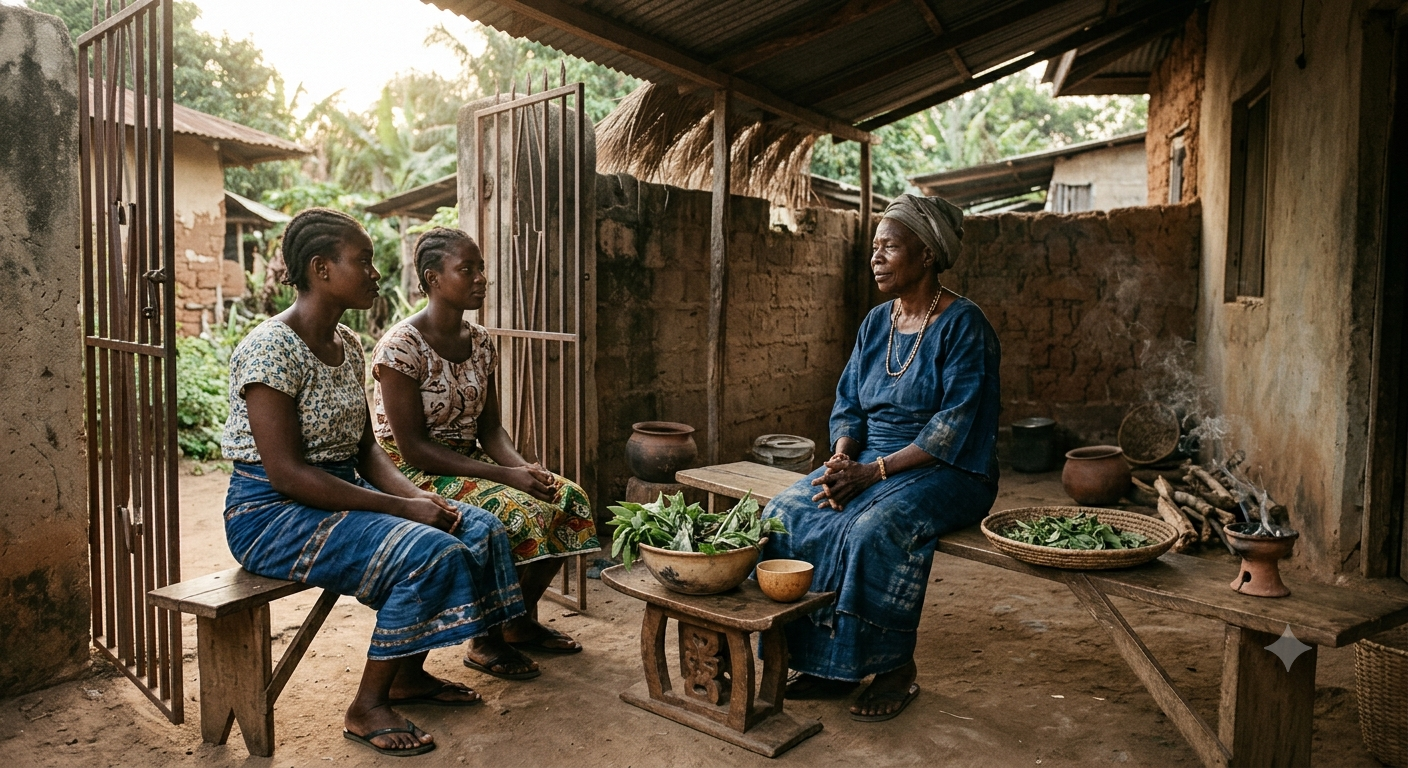
There was no ultrasound machine in the room.
No examination couch. No blood pressure monitor. No laboratory request forms.
Just an elderly woman sitting quietly on a wooden bench, waiting for the next person to walk through her gate.
When I first began documenting indigenous maternal healthcare among the Yoruba, I assumed pregnancy became “real” only after the signs we have all come to recognize; a missed period, a growing belly, perhaps an ultrasound image proudly shared with family and friends.
Then I met Iya Ewe.
She smiled when I asked how she knew a woman was pregnant.
“You people wait until the stomach grows,” she said. “We don’t.”
Over the following weeks, I watched women arrive at her home. Some looked no different from any other woman in the community. They laughed, chatted, and carried themselves as though nothing had changed. Yet, according to the traditional birth attendants, pregnancy had already begun its quiet work inside their bodies.
To these knowledge holders, pregnancy is not something that suddenly appears when the abdomen expands. It reveals itself through subtle changes that generations of observation have taught them to recognize.
But what fascinated me even more was what happened after they confirmed a pregnancy.
For the women in their care, antenatal care began immediately.
Not with registration forms.
Not with numbered clinic cards.
With conversation.
They asked about the woman’s body.
Her appetite.
Her sleep.
Her previous pregnancies.
Her fears.
Her family.
And then came a question I had never imagined anyone would ask.
“What kind of child is she carrying?”
At first, I thought they were asking whether the baby was a boy or a girl.
They were not.
They explained that every pregnancy carries its own story. Some pregnancies progress easily. Others require closer attention, not simply because of physical symptoms but because the unborn child may have spiritual circumstances that need to be understood.
One traditional birth attendant explained it this way:
“It is not enough to know that a woman is pregnant. We must also know the kind of child she is carrying and whether there are spiritual issues that can affect the pregnancy or the delivery.”
Whether one agrees with this worldview or not, it reveals something important about Indigenous Knowledge Systems.
Health is never reduced to the body alone.
The physical, emotional, social, environmental, and spiritual are understood as interconnected. Pregnancy is therefore monitored not only for signs of illness but also for signs that the mother may need reassurance, dietary changes, herbal support, massage, or spiritual protection.
No two women receive exactly the same care.
One may leave with herbs for persistent nausea.
Another with dietary advice.
Another with instructions to return in a few days for further observation.
Another simply needs someone to reassure her that what she is experiencing is normal.
The care is remarkably personal!
Too often, conversations about maternal healthcare in Africa are framed as a choice between “traditional” and “modern” medicine.
My time with Yoruba knowledge holders suggested a more interesting question.
Leave a Reply